Assessment Structure: Tax Base, Tax Rate, Proportional, Regressive, and Progressive Taxation :
To figure most charges, it is important to know the duty base and the expense rate. The duty base is the add up to which an expense rate is connected. The duty rate is the rate of the assessment base that must be paid in duties. So if the assessment base equivalents $100 and the expense rate is 9%, then the duty will be $9 (=100 × 0.09). Relative expenses apply the same assessment rate to any wage level, or for any size duty base. So if Bill wins $50,000 and Jane acquires $100,000, and the assessment rate is 10%, then Bill will owe $5,000 in duties while Jane will owe $10,000. Numerous state wage charges and all business expenses are corresponding duties. Government managed savings and Medicare assessments are likewise corresponding subsequent to the same expense rate is connected to any earned wage up to the Social Security limit, which, for 2011, is $106,800. The Medicare duty is a relative expense that applies to all earned wage and is equivalent to 2.9%, starting 2011.
A backward assessment is one that is contrarily corresponding to salary — the lower the wage, the higher the duty in connection to wage. Most backward charges are surveyed on items and administrations in which the assessment is a rate of the expense of the item or administration. Thus, while paying the duty, a destitute individual pays as much as the rich individual. The most widely recognized types of backward assessments are deals expenses and esteem included duties (VAT). The biased impacts of a backward expense is frequently alleviated by installments to poor people and by exempting fundamental items and administrations, for example, sustenance, from the backward duty.
A dynamic expense applies a higher assessment rate to higher salaries. So if the expense rate on $50,000 is 10% and 20% for $100,000, then, proceeding with the above illustration, Bill still owes $5,000 in duties while Jane will need to pay $20,000 in assessments. Then again, all dynamic charges are organized as a minor expense, which implies that the dynamic assessment rate is just connected to that some portion of the pay which is more noteworthy than a sure sum. The bit of the assessment base that is liable to a specific expense rate, is known as a duty section, which dependably has lower and furthest points of confinement, with the exception of the top duty section, which has no maximum breaking point. The accompanying assessment sections apply for 2013 and from that point: 10%, 15%, 25%, 28%, 33%, 35%, 39.6%. The 39.6% section was included 2013. To see the present rates distributed by the IRS, look down to the base of the present expense table from the guidelines for Form 1040.
Proceeding with the above illustration, if the 20% assessment rate is just connected to that divide of the pay in the middle of $50,000 and $100,000, then Jane would owe $5000 on the first $50,000 of wage and $10,000 on the second $50,000 of wage, bringing about an aggregate expense obligation of $15,0.
Without marginal tax rates, a progressive tax would skew economic
decisions and would be viewed as unfair. For instance, if the 20% tax
rate was applied to all earned income and Jane only earned $60,000, then
she would have to pay $12,000 in taxes, which is 2.4 times more than
Bill's taxes, even though she only made 1.2 times more than Bill. To
take a more extreme example, consider what happens if Jane makes
$50,001. She would have to pay slightly more than $10,000 which is $5000
more than what Bill would have to pay, even though he only earned one
dollar less. Hence, without marginal tax rates, a pay increase could
actually result in a decrease in disposable income. A person's tax
bracket is the highest tax bracket applicable to her income level.
Because
of marginal tax rates, the tax rate that one actually pays is not
knowable just from their tax bracket, so another rate, called the effective tax rate (aka average tax rate),
is calculated by dividing the actual taxes paid by the tax base. In
other words, the total tax calculated by multiplying earned income times
the effective tax rate will equal the same tax that is calculated by
multiplying the amount of income in each tax bracket by the respective
marginal tax rate and summing them all up. So in example 2, since Jane
earned $100,000 and paid $15,000 in taxes, her effective tax rate is 15%
(= $15,000 ÷ $100,000).
The federal
income tax and many state taxes are progressive. Although the federal
income tax itself is progressive, the effective tax rate that is based
on all the taxes collected by the federal government is progressive only
until the Social Security limit is reached. Thereafter, the effective
tax rate either declines or levels off with increasing income, since
people who make more than the Social Security limit do not have to pay
the 12.4% Social Security rate on any income earned above the limit, as
can be seen from the following table for a single person who is not a
head of the household (Note: For a self-employed
person, the tax code allows the deduction of the employer's half of the
payroll tax, which results in a net self-employment tax of 14.13%.
The tax code also allows the deduction of the employer's portion of the
tax, the value of which depends on the taxpayer's marginal tax bracket,
but since this does not change the effective tax rate very much, it is
ignored in the table below. The following table assumes that a single
person with no dependents pays the entire payroll tax, which is true for
the self-employed, but also applies to employees. Even though employees
technically only pay ½ of the payroll tax, most economists agree, that
most employees pay the other half through lower wages or through higher
unemployment. For more info, see Tax Incidence: How The Tax Burden Is Shared Between Buyers And Sellers):
The 2011 standard deduction of $5,800 and the personal exemption of $3,700 for a single person was deducted from the earned income to calculate the income tax in the above table. However, payroll taxes
applies to all earned income. As you can see from the chart below, the
federal tax on earned income is not nearly as progressive as it might
seem by just looking at marginal tax rates. For instance, note the fact
that someone who makes $1 million has an effective tax rate of 36.33%,
and someone who earns $100,000 has an effective tax rate of 32.5%, which
is only 3.83% less than what the millionaire pays.
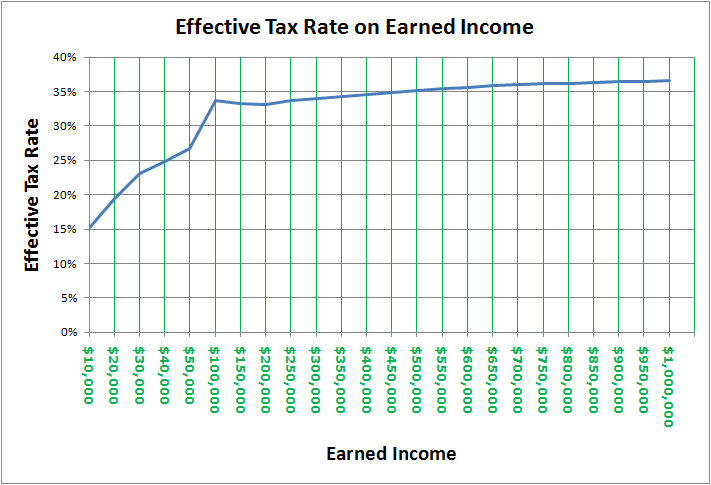
The Wealthy Really Do Have It Better
The above table is misleading. It suggests that the wealthy pay a higher effective tax rate on their income than poorer people. However, because of favorable tax treatment for investment income and, especially for capital gains, and because large amounts of wealth can be transferred through gifts and inheritance tax-free, the wealthy actually pay a far lower effective tax rate if the taxes that they paid is divided by all of their income, including investment income and inherited wealth.For instance, according to IRS statistics, in 2007, the top 400 taxpayers of the United States received an average of $344.8 million and paid only 17.2% of that income in taxes, including payroll taxes that they may have paid. If you look at the above table again, you will note that someone who makes a mere $20,000 per year pays an effective tax rate of 19.2% — even after subtracting the standard deduction and personal exemption! Furthermore, hedge fund managers, some who make more than $1 billion per year, are exempted from paying any payroll taxes on their performance fee, which is usually most of their compensation if they are profitable, thanks to their Republican friends in Congress.
Even though, in 2011, the United States is, and will be, well into the future, deeply in debt, the Republicans are hell-bent on preventing any tax increases on their wealthy benefactors, even though this enormous federal deficit was created by the Republicans when, after inheriting a surplus from the Clinton administration, decided to slash taxes on the wealthy and precipitated the credit crisis of 2007 - 2009 by removing or relaxing regulations on Wall Street and by limiting their oversight. Indeed, even after the calamity that has befallen the United States economy, the Republicans continually fight to prevent any restrictions or any additional oversight on their Wall Street friends.
However, the largest single factor that has created this inequity in taxation is the fact that earned income is the most highly taxed income, even though, for maximum economic growth, earned income should be the least taxed, because the higher price of wages due to these income taxes decreases the demand for labor while the lower amount received by the suppliers of this labor reduces supply — in other words, it lowers the incentive for work. In economics, this is referred to as the deadweight loss of taxation. Indeed, it is only work that increases the economic wealth of any society. Even investments cannot create true economic wealth unless it is used to put people to work, and transferred wealth actually reduces economic wealth because the people that receive it have a reduced incentive to actually work. Hence, the prudent economic policy of any government should be to tax work the least, not the most.
0 komentar:
Post a Comment